Can Locksmiths Program Modern Smart Keys? 2026 Guide
Table of Contents
Can Locksmiths Program Modern Smart Keys? The Short Answer
Why Capability Varies by Locksmith, Vehicle, and Key System
Smart Keys, Proximity Keys, Push-to-Start Keys, and Key Fobs Explained
Smart Key Programming: How a Vehicle Authenticates a Programmed Key
What Actually Happens During Authentication
Why Some Vehicles Are Harder Than Others
Diagnostic Equipment and Programming Tools Locksmiths Use
Make, Model, and Year Compatibility: A Checklist Before You Book
Push-to-Start Key Programming and Duplicating a Spare Key
Smart Key Replacement When All Keys Are Lost
Smart Key Programming Cost: What Drives the Price
The Variables That Move the Price
What the Ranges Look Like
Time Expectations
Security, Ownership Verification, and Anti-Theft Safeguards
When a Locksmith Can't Help: Dealer Programming and Alternatives
Frequently Asked Questions
Last Updated: October 12, 2026
Can Locksmiths Program Modern Smart Keys? The Short Answer
Yes, many locksmiths can program modern smart keys, but not all of them, and not for every vehicle. At A Ej Locksmith, our Master Locksmith handles smart key programming for many vehicles.
A locksmith who can cut a traditional car key may not have the tools to program a smart key at all. Below: how smart keys work, which vehicles a locksmith can cover, what drives the cost, and when you need a dealer.
Key Takeaway The exact question "can locksmiths program modern smart keys" has no single yes or no. It comes down to three things: the locksmith's tools, your vehicle's make and model, and the year it was built.
Why Capability Varies by Locksmith, Vehicle, and Key System
A locksmith's ability to program a smart key depends on the tools they own and the vehicles those tools support.
The National Highway Traffic Safety Administration tracks vehicle safety and theft standards, which is part of why automakers keep tightening key security.
Three factors decide whether a locksmith can help:
Their equipment: Up-to-date programming tools and software subscriptions
Your vehicle: Make, model, and model year
The key type: Basic transponder versus advanced proximity key
A shop with current tools and broad vehicle-specific coverage is your best bet. One with older gear may send you to the dealer.
Smart Keys, Proximity Keys, Push-to-Start Keys, and Key Fobs Explained
These terms get used interchangeably, but they mean different things.
Smart key: A key that talks to your car wirelessly and can start it without a physical turn. It contains a transponder chip and a remote.
Proximity key: A smart key that unlocks and starts the car when you're near it; the sensor detects the fob in your pocket or bag.
Push-to-start key: A system where you press a button to start the engine instead of turning an ignition. It relies on a proximity key being present.
A transponder is a small chip inside the key that the vehicle's immobilizer reads before it allows the engine to start. Without a matched chip, the car won't run, even if the key is cut correctly.
Smart Key Programming: How a Vehicle Authenticates a Programmed Key
Programming a smart key means teaching your vehicle to trust a new key. The car's computer stores a unique code, and the new key must be matched to it.
Here's the simple version of what happens:
The locksmith connects a diagnostic tool to your vehicle, usually through the OBD-II port under the dash.
The tool reads the car's computer and confirms your ownership.
The new key's chip is paired to the vehicle's security system.
The car authenticates the key, and it now starts the engine.
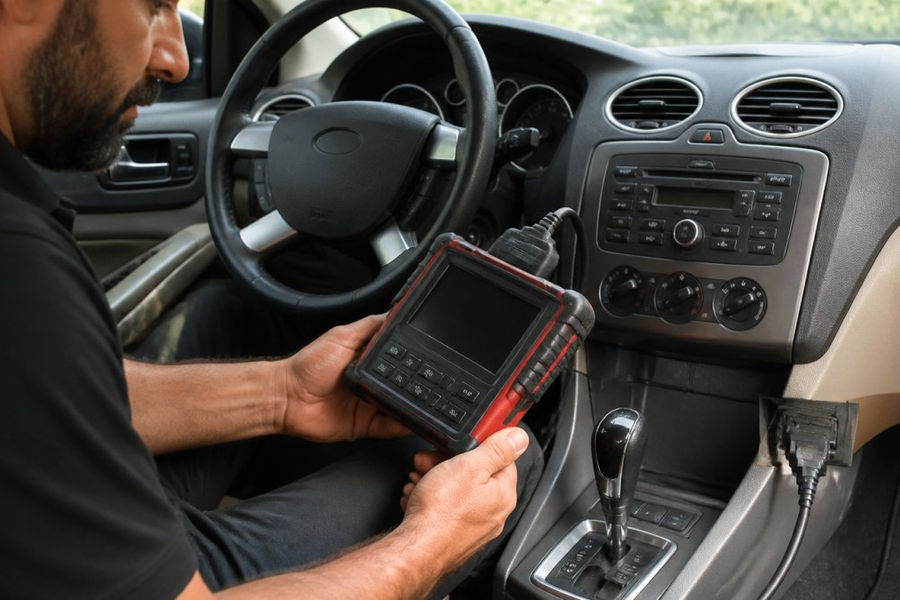
This electronic authentication is why you can't just buy a key online and expect it to work.
What Actually Happens During Authentication
What decides whether a job is easy, hard, or impossible is the handshake between the new key and the vehicle's security modules. Most modern vehicles use one of two pathways:
On-board programming. The locksmith works through the vehicle's own interface, the OBD-II port, a dashboard sequence, or a dedicated programming mode. The immobilizer and body control module (BCM) do the matching. Faster, cheaper, and covers many domestic and Asian models.
Off-board programming. The locksmith removes the immobilizer module, BCM, or key slot and reads/writes memory directly with a bench tool. Common on certain European models and vehicles with locked on-board access. It takes longer, needs specialized equipment, and carries more risk if the module is damaged.
Either way, the core mechanism is a seed-and-key exchange: the vehicle sends a random challenge (the seed), the new key's transponder computes a response using a secret algorithm (the key), and the vehicle compares the result. If it matches, the key is added to the authorized list; if not, it's rejected, even if it's cut perfectly and the fob buttons work.
Why Some Vehicles Are Harder Than Others
Three vehicle-side factors drive difficulty:
Where the security data lives. Older transponder systems keep the key list in the immobilizer module; newer vehicles use the BCM or a gateway module, which may be encrypted.
Whether the manufacturer requires online authentication. Some automakers require a live server connection to release a security code before a new key can be added. Without it, no aftermarket tool can finish the job.
How many keys the vehicle will accept. Most systems cap the number of keys. If the cap is reached, the locksmith must erase old keys before adding new ones, the same step that locks out a lost or stolen key.
A common pattern: the same locksmith who programs a 2018 domestic pickup in fifteen minutes may need an hour and a bench tool for a late-model European sedan, and may refer a brand-new luxury model to the dealer. It's not a skill gap, it's a tool-and-access gap.
Pro Tip When you call a locksmith, ask two questions: "Do you have current programming tools?" and "Have you done my exact make, model, and year before?" A quick, specific answer tells you a lot. If they hesitate on the second question, ask whether the job is on-board or off-board, a shop that knows the difference is a shop that has done the work.
Diagnostic Equipment and Programming Tools Locksmiths Use
A modern automotive locksmith relies on diagnostic equipment that connects to your car's computer through the OBD port: key programming devices, transponder readers, and software covering many makes and models. Some tools need paid subscriptions for the newest vehicles, often sold per manufacturer or model year, a shop covering ten brands may pay for ten licenses. Tool coverage changes constantly: a locksmith with current software can handle 2026 models, while one who hasn't may only cover cars a few years old.
Key Takeaway Authentication isn't one thing, it's a handshake between the key and a specific module, using a specific pathway. That's why the same locksmith can be the right call for one car and the wrong call for the next one in line.
Make, Model, and Year Compatibility: A Checklist Before You Book
Vehicle compatibility is the biggest factor in whether a locksmith can program your key. Run through this checklist before booking.
Write down your make, model, and model year
Note whether your key is a smart key, proximity key, or basic fob
Confirm if your car is push-to-start or turn-key
Situation | Locksmith Can Usually Help | May Need a Dealer |
Spare key, one key exists | Yes | Rarely |
All keys lost, common brand | Often | Sometimes |
Newest model year | Sometimes | Often |
Older transponder key | Yes | Rarely |
Certain European models | Depends on tools | Often |
This table isn't a guarantee, but it's a realistic starting point. A quick phone call with your details will confirm it.
Push-to-Start Key Programming and Duplicating a Spare Key
Push-to-start key programming works much like other smart key jobs: the locksmith pairs a new fob to the vehicle, and the car authenticates it before the button will start the engine. Duplicating a spare is easier, with one working key, the locksmith can often clone or add a second key using it as the source. If you lose your only key, the job gets harder and more expensive, so the cheapest time to get a duplicate is before you need one.
Watch Out Driving with a single key is a gamble. If that key is lost, all-keys-lost programming takes longer and costs more, and some vehicles may need a tow to a dealer.
Smart Key Replacement When All Keys Are Lost
All keys lost is the hardest scenario, but a locksmith can often still help: prove you own the vehicle, then wipe the old keys from the car's memory and program new ones.
Here's what to expect:
You'll show proof of ownership, like your registration and ID
The locksmith erases the lost keys from the vehicle's system
New keys are cut and programmed on site
The erase step is a security feature: a thief who finds your lost key can't use it. Some vehicles make this harder, certain models need special security access or an online connection to the automaker's system, and without that access, a dealer may be the only path.
Smart Key Programming Cost: What Drives the Price
Smart key programming cost depends on several things, not just the key itself, two jobs that sound identical can land at very different prices. Use these variables to sanity-check any quote.
The Variables That Move the Price
Key type. A basic transponder key (chip only, no buttons) is cheapest. A remote-head key adds buttons. A full smart or proximity fob with push-to-start is most expensive.
Vehicle make, model, and year. Luxury brands and newer models cost more: OEM blanks and software licenses cost more, and the procedure takes longer.
Whether you have a working key. Adding a spare with one working key is cheapest. All-keys-lost is most expensive, since the locksmith must verify ownership, erase the old key list, and often use a slower procedure for the first new key.
What the Ranges Look Like
Exact prices vary by market, shop, and vehicle, so treat any single number with suspicion. What's consistent is the shape of the pricing:
Adding a spare when you have a working key: lowest cost, the existing key does most of the authentication work.
Replacing a single lost key when you still have one: moderate, the locksmith cuts and programs a new key, but the vehicle is already in a known-good state.
All keys lost: highest cost, ownership verification, key cutting, erasing the old key list, and programming the first new key, plus on some vehicles a tow or dealer visit for security access.
Watch Out Be cautious of any quote that doesn't ask for your make, model, and year first. A price given before those questions is a guess, not a quote. Also be wary of unusually low quotes for all-keys-lost jobs, that's the scenario where corners get cut, and a poorly programmed key can leave you stranded again.
Time Expectations
Price and time move together. A spare-key job on a common model is often a same-day, on-site appointment measured in minutes. An all-keys-lost job on a newer or high-security vehicle can take considerably longer and may require ordering a key or coordinating with the dealer for a security code.
We keep our pricing transparent and fair, and you can see current rates on our website before you book, so there are no surprises when we arrive.
Key Takeaway The biggest cost jump comes from losing all your keys. Keep a spare, and you avoid the most expensive version of this job, and the one most likely to involve a tow or a dealer.
Security, Ownership Verification, and Anti-Theft Safeguards
Programming a smart key is a security job, so proof of ownership is non-negotiable.
Expect to provide:
Your vehicle registration or title
A photo ID matching the registration
Sometimes a VIN check against the documents
The anti-theft side matters too: when a locksmith programs a new key, they often erase the old ones, locking out any lost or stolen key.
Modern vehicles also use rolling codes and encrypted signals. The Federal Trade Commission's guidance on auto fraud explains how consumers can spot related scams and protect themselves.
At A Ej Locksmith, we're fully licensed, bonded, and insured, so you can verify who you're letting near your car.
When a Locksmith Can't Help: Dealer Programming and Alternatives
Sometimes a dealer is the right call, and an honest locksmith will say so.
Signs you may need a dealer:
Your model requires online access to the automaker's system
The locksmith lacks vehicle-specific coverage for your car
Your vehicle is brand new with the latest security
If that happens, ask about alternatives first: some locksmiths can order the right key and try again, and others partner with dealers for the security step.
Losing a smart key or facing an all-keys-lost situation is stressful, but you have more options than you might think.
Frequently Asked Questions
Can a locksmith program a smart key?
Yes, many automotive locksmiths can program smart keys, proximity keys, and push-to-start fobs using diagnostic equipment that connects to your vehicle's computer. Capability depends on the locksmith's tool coverage and your specific make, model, and year. A mobile locksmith with up-to-date programming tools can often complete smart key programming on-site in under an hour, saving you a trip to the dealership.
How much does smart key programming cost?
Smart key programming cost depends on the vehicle, the type of key, and whether you need a new fob or just programming. Factors include make and model, whether a spare key already exists, and whether the vehicle needs a security access code. A locksmith typically charges less than a dealership for the same job. Contact A Ej Locksmith for a quote based on your vehicle.
Can a locksmith make a smart key if all keys are lost?
Yes, in many cases. When all keys are lost, the locksmith must verify ownership, then use specialized equipment to erase old key data from the vehicle computer and program a new key from scratch. Some vehicles require a security access code or dealer-level authentication. A mobile locksmith with the right tools can often handle an all-keys-lost situation on-site.
Do I need to bring my car to a locksmith to program a smart key?
No. Mobile locksmiths bring diagnostic equipment and programming tools directly to your location, whether that is your home, office, or roadside. The vehicle must be present for programming because the tool connects to the car's computer. On-site service saves you the hassle of towing and often costs less than a dealer visit.
Contact Us
Comments